
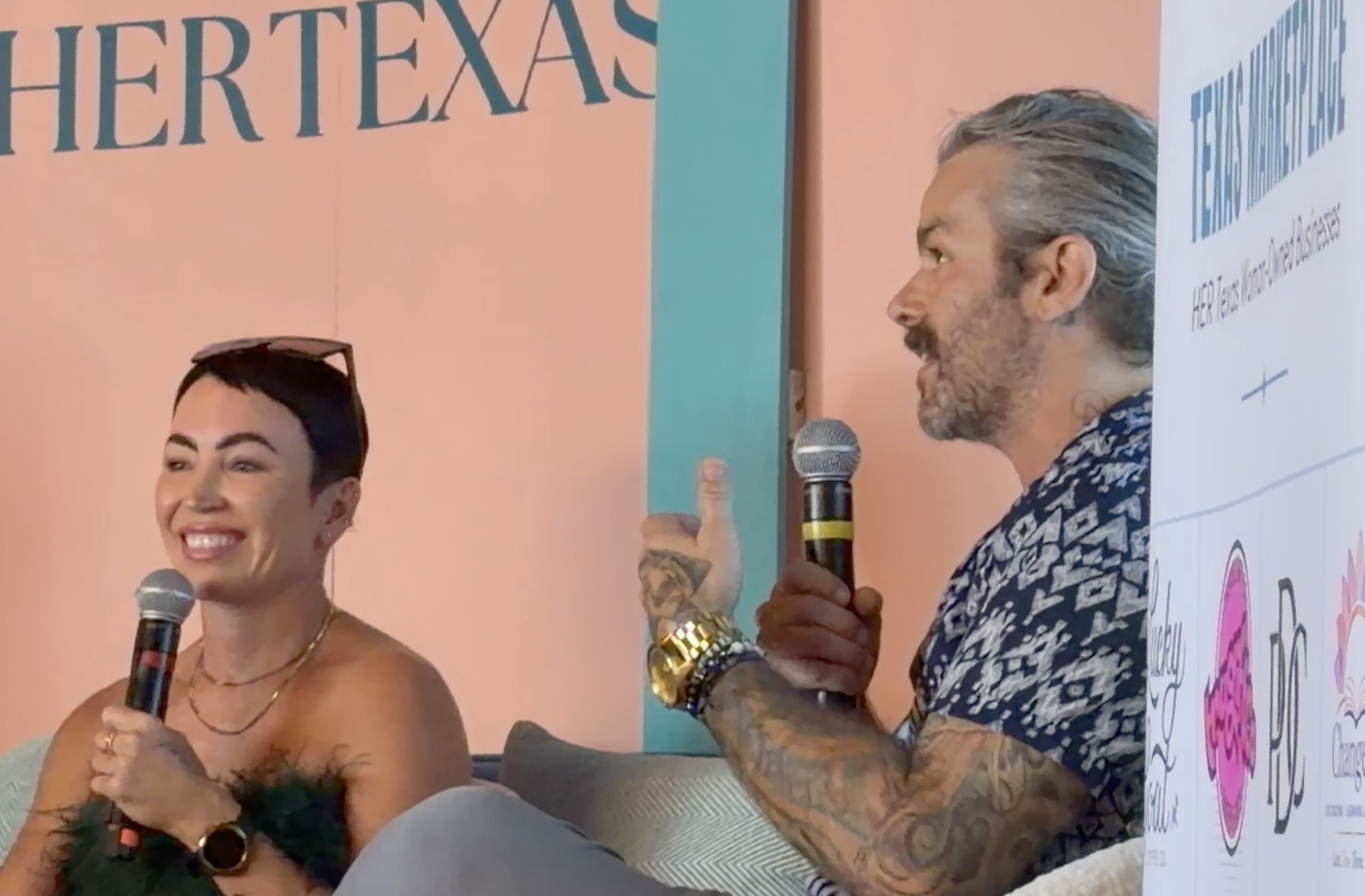
Oak Cliff Pilates co-founders Amanda Mecsey and Kiel Jared, joined a panel at Her Texas July 12th to talk about starting over, saying yes before you’re ready, and building a community on purpose. Here’s what came out of it.
The question was simple enough: a lot of women believe they’ll take care of themselves once things slow down. What does waiting actually cost us?
Amanda didn’t hesitate.
“Time. Precious time.”
Then she told the room something most founders keep to themselves. She started over at 40.
The park, the reformer, and the lunch that changed everything
Before there was a studio, there was grass.
Amanda had learned to teach Pilates after moving to Dallas, and it became her second act — free mat classes at Kidd Springs Park, privates out of the house. At one point they pulled the dining table out and moved a reformer in, because that’s what the work required.
Then came a partnership. And then came the lunch where that partnership ended.
“We sat down and had that conversation,” Kiel said. “And we drove away and said — we’re doing this ourselves.”
Two weeks later, they had a space and taught their first class. No investors. No cushion.
“I’ll jump off the cliff and figure out the parachute on the way down.”
The studio she thought she’d stay in forever
Here’s the part people get wrong about growth: Amanda never wanted an empire.
“It was a cute little boutique studio. That’s where I thought I’d stay,” she told the room. “I taught every single class. I had two trainers at the time. And I was fine with that.”
The community had other plans.
Then a wall came down in a storm. The power went out. The landlord wasn’t interested in helping. So Amanda and Kiel drove to Home Depot, bought generators, hauled them in, and ran the studio’s own electricity and A/C off of them — refilling the tanks every two hours. Two in the morning. Four in the morning. Whatever it took so nobody’s class got canceled.
That’s not a growth strategy. That’s just showing up.
Ten doors, and the men behind them
The second location took a year and a half to find. Ten spaces. Ten no’s.
“I got outbid by everybody,” Amanda said. “I was a woman. I didn’t make enough money. I’ve had men tell me I’m a woman, so I can’t have that second location.”
At some point she made peace with staying one studio. And then a space came open, and she said yes while she was still scared.
She financed it the hard way, refinancing her house rather than taking money from anyone. “I never took a dime from anyone. If I can’t do it myself, I’m not going to do it at all.”
By the third studio, the math was worse and the fear was louder. She wanted to wait.
“I wanted to wait so bad, because I was like — we can’t do this. We cannot take this on. What happens to the staff?”
They did it anyway. It was the location they’d always wanted. And people started coming out of the woodwork asking to work there.
“Have we struggled? Absolutely. Have I cried into my pillow? Absolutely. But I believe so much in it, and in the trainers we have, and in what we’re building.”
The habit and the investment
Two questions from the moderator got the sharpest answers of the hour.
One habit, starting tomorrow morning?
“Don’t tell yourself no,” Amanda said. “Believe in yourself more. You have more in you than you think you have. The world tries to tear you down a little — it’s exhausting sometimes, especially as a woman. Don’t let anybody tell you you’re not good enough.”
Kiel’s version was about momentum: ideas are endless. Making things is rare. “It’s much easier to just make the thing you’ve been thinking about than it is to keep thinking about it.”
One investment every woman should make?
“Yourself. We are our own investment.” Then, dryly: “Not Bitcoin.”
Community isn’t a marketing plan
The last stretch of the panel is the part that explains OCP better than any ad we’ve ever run.
Amanda’s whole reason for starting was a room she couldn’t find anywhere else. “When I used to go work out, everyone was walking in, everyone was walking out. Nobody was really talking to each other. I wanted a place where people could come in — all shapes and sizes, all ethnicities. A safe place.”
So the studio was built for what happens after the workout too. Numbers get exchanged. Somebody buys a house from somebody. Somebody does somebody’s taxes. “It wasn’t just about the workout.”
And in the neighborhood, the approach was the opposite of what most brands do. No asking local businesses for free stuff.
“We tried to become friendly with every business owner. We’d say, let’s buy something from you — this is our favorite coffee shop, let’s make sure they know we care about them.” Pop-ups, partnerships, collabs. Spread the love first, see what comes back.
That’s also why OCP doesn’t feel like the stuffy, bougie studio that makes people feel insecure the second they walk in. That was never the goal. Inclusivity wasn’t a value statement we bolted on — it’s the reason the doors opened.
Five years in
Somewhere in the Q&A, someone asked how you know when it’s time to grow. Amanda laughed, because she still doesn’t think of it that way.
“You go so much that you forget. Some days I think — wow, we were at a park. That’s where it started. And I can’t believe where I’m at.”
Three studios. 50+ trainers. Around 500 new people walking through our doors every month. Five years as of June, 2026.
Not because anybody waited until it was safe.
Come see what we built
New here? Three classes for $25, good at Bishop Arts, Uptown, or Lower Greenville.